

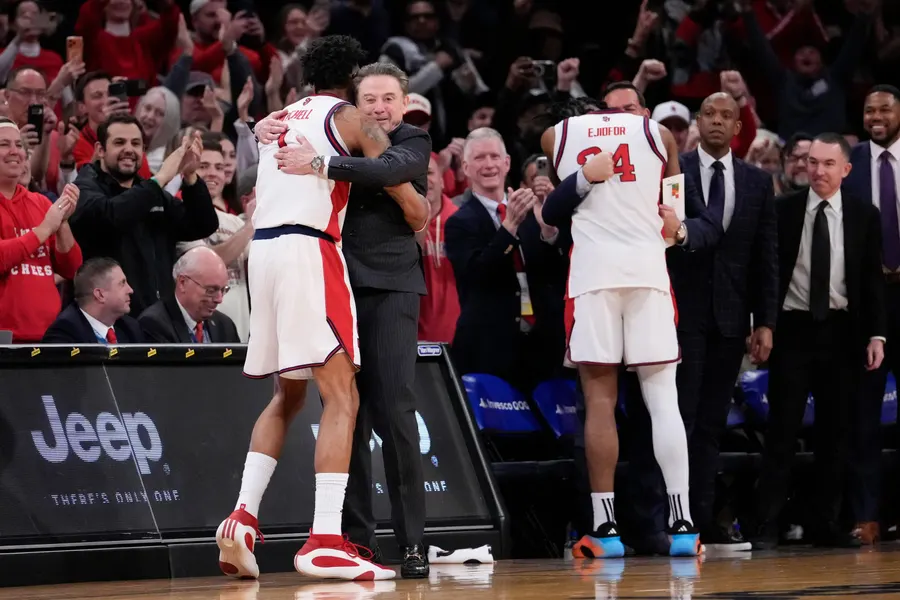
The Red Storm Ascendant: Analyzing St. John’s Systematic Dominance in the Big East
In a clinical display of tactical superiority and organizational resilience, the St. John’s University basketball program solidified its status as the preeminent power in the Big East conference this past Saturday. By defeating the University of Connecticut to secure their second consecutive Big East tournament championship, the Red Storm have achieved a rare “double-double”—pairing back-to-back tournament trophies with two successive regular-season titles. This milestone is not merely a testament to a singular run of athletic form; rather, it represents the culmination of a multi-year strategic overhaul that has transformed the program into a model of institutional excellence and competitive consistency.
The significance of this achievement cannot be overstated within the context of modern collegiate athletics. In an era defined by the volatility of the transfer portal and the complexities of Name, Image, and Likeness (NIL) valuations, maintaining a championship-caliber culture across multiple seasons is an arduous task. St. John’s has successfully navigated these headwinds, building a roster that balances veteran leadership with explosive recruitment. This latest victory over a perennial powerhouse like Connecticut serves as a definitive market signal that the power dynamics within the Big East have undergone a structural shift, positioning the Red Storm as the conference’s gold standard.
Operational Excellence and the Blueprint for Sustained Success
The Red Storm’s trajectory over the last twenty-four months reflects a masterful execution of program-building that mirrors high-level corporate restructuring. By securing both the regular season and tournament titles in consecutive years, the coaching staff has demonstrated an elite ability to manage both long-term strategic goals and short-term tactical demands. Winning the regular season requires depth, injury management, and consistent performance across a grueling schedule; winning the tournament requires high-pressure execution and the ability to make rapid adjustments in a condensed timeframe. Excelling at both simultaneously suggests a level of operational discipline that is rare in the collegiate ranks.
From a technical standpoint, the victory on Saturday highlighted the program’s defensive identity and offensive efficiency. St. John’s has leveraged a recruitment strategy that prioritizes high-IQ players who fit a specific system, rather than simply chasing raw talent. This “culture-first” approach has yielded a synergistic roster where the collective output exceeds the sum of individual parts. In the business of sports, this is the ultimate competitive advantage: creating a system that is resistant to the departure of individual stars and capable of reproducing results year after year.
The Competitive Landscape: Overthrowing the Established Order
To understand the weight of this championship, one must analyze the opponent. The University of Connecticut represents the historical benchmark for success in Northeast basketball. For St. John’s to consistently outmaneuver a program with such deep resources and championship pedigree indicates a successful “hostile takeover” of the conference’s top tier. This rivalry has become the central narrative of the Big East, but with four major trophies in two years, St. John’s has effectively ended the debate regarding current supremacy.
This dominance has profound implications for the “market share” of the Northeast basketball corridor. Championship success directly correlates with a program’s ability to attract top-tier talent and secure lucrative endorsements. By establishing a winning tradition at Madison Square Garden,the world’s most famous arena and the spiritual home of the Big East,St. John’s has reclaimed its status as the primary destination for elite recruits in the region. The brand equity of “The Red Storm” has reached its highest valuation in decades, creating a virtuous cycle of success that makes the program increasingly difficult to displace.
Commercial Implications and Brand Evolution
Beyond the hardwood, the financial and commercial dividends of this back-to-back championship run are substantial. Success in the Big East tournament is a primary driver of ticket sales, donor contributions, and merchandise revenue. For the university, the athletic program serves as a “front porch” for the institution, driving increased applications and national visibility. The Red Storm’s dominance provides a stable platform for corporate partnerships and NIL collectives to invest with confidence, knowing that the program offers a high return on visibility during peak national broadcast windows.
Furthermore, the “New York City’s Team” narrative has been revitalized. In a saturated sports market, St. John’s has carved out a unique position as a winner in the nation’s largest media market. This proximity to the global centers of finance and media provides the program with a competitive edge in professional development and branding for its student-athletes, further distancing itself from conference rivals located in smaller markets. The institutional stability showcased by this championship run is a key asset for the Big East as a whole, bolstering the league’s television rights value and overall prestige.
Concluding Analysis: The Path Forward
As the dust settles on another championship celebration, the focus inevitably shifts to the national stage and the long-term sustainability of this dynasty. St. John’s has proven that it can conquer the Big East with systematic regularity; the next phase of the program’s evolution will be defined by its ability to translate this regional dominance into a deep run in the NCAA Tournament. The infrastructure is clearly in place, and the “winning habit” has been firmly established within the locker room.
In conclusion, the Red Storm’s victory on Saturday was more than just a win in a box score; it was a demonstration of a program operating at the peak of its powers. By aligning strategic recruitment, elite coaching, and institutional support, St. John’s has built a durable competitive advantage. In the high-stakes environment of Division I athletics, the Red Storm have proven that they are not merely participants in the Big East,they are its architects. The challenge for the rest of the conference will be finding a way to disrupt a machine that currently shows no signs of slowing down.