

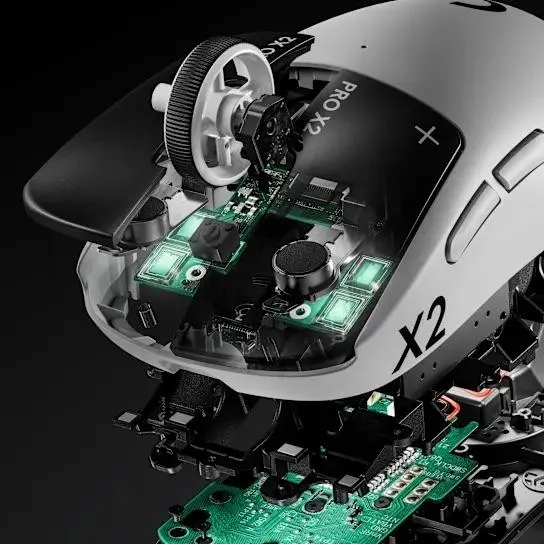
Precision Engineering and Market Evolution: An Analysis of the Logitech G Pro X2 Superstrike
In the high-stakes ecosystem of professional esports and premium computer peripherals, the margin between victory and defeat is frequently measured in milliseconds. Logitech, a long-standing titan in the peripheral industry, has once again attempted to redefine the boundaries of hardware performance with the introduction of the G Pro X2 Superstrike. Marketed as featuring the “Fastest, Fully Customizable Click,” this device represents more than just an incremental upgrade; it is a strategic maneuver designed to consolidate Logitech’s dominance in a market increasingly crowded by specialized boutique manufacturers and established tech giants alike. The Superstrike arrives at a critical juncture where the demand for ultra-low-latency input and tactile personalization has transitioned from niche enthusiast requirements to essential professional standards.

The “Pro” series has historically served as Logitech’s flagship laboratory for innovation, where research and development resources are poured into solving the specific physiological and technical constraints of competitive gaming. With the Superstrike, the company addresses the two primary pillars of peripheral excellence: speed of execution and the subjective “feel” of hardware interaction. By centering the product’s identity around a customizable click, Logitech is pivoting away from the one-size-fits-all philosophy, acknowledging that the ergonomic requirements of a professional athlete are as diverse as the disciplines they compete in. This report examines the technical architecture, market implications, and strategic significance of the G Pro X2 Superstrike.
The Mechanics of Response: Engineering the Fastest Customizable Click
At the core of the G Pro X2 Superstrike’s value proposition is its proprietary switch technology. While traditional mechanical switches have long been the industry standard, they are inherently limited by physical debounce delays,the time required for a metal contact to stop “bouncing” after being struck. Logitech’s move toward a hybrid optical-mechanical system in the Superstrike effectively bypasses these traditional bottlenecks. By utilizing light-based actuation, the device achieves near-instantaneous signal processing, virtually eliminating the latency associated with electrical signal stabilization.
The “Fully Customizable” aspect of the click mechanism is perhaps the most significant engineering feat of this iteration. Historically, users were forced to choose between the tactile, heavy resistance of a mechanical switch or the light, rapid response of an optical one. The Superstrike offers a software-integrated layer of control that allows users to calibrate actuation points and reset timings. This level of granularity ensures that the hardware can be tuned to prevent accidental clicks,a common issue in high-tension environments,while maintaining a hair-trigger response for twitch-based actions. This customization is not merely a software gimmick; it is backed by an internal tensioning system that maintains consistent tactile feedback regardless of the electronic settings, ensuring that the physical sensation of the click remains crisp and reliable over millions of cycles.
Strategic Market Positioning and the Competitive Landscape
The release of the G Pro X2 Superstrike is a calculated response to the aggressive expansion of competitors such as Razer, SteelSeries, and Finalmouse. As these companies push the envelope with higher polling rates,reaching up to 8,000Hz,and increasingly lightweight chassis, Logitech’s strategy has shifted toward “functional reliability.” While raw specifications are important, the professional segment prioritizes consistency and battery efficiency over theoretical maximums that the human hand cannot realistically perceive. The Superstrike bridges this gap by offering elite-tier speed without sacrificing the legendary build quality and wireless stability of the LIGHTSPEED protocol.
From a business perspective, the G Pro X2 Superstrike is positioned as a high-margin “halo” product. It serves to elevate the entire G Pro brand, creating a trickle-down effect that bolsters the sales of Logitech’s mid-range offerings. By securing endorsements from top-tier esports organizations, Logitech ensures that the Superstrike becomes the aspirational standard for the broader consumer market. The emphasis on “customizability” also opens a new avenue for consumer retention; once a user has perfected their specific click profile within the Logitech G Hub ecosystem, the friction of switching to a competitor’s ecosystem increases significantly. This “software-hardware lock-in” is a sophisticated method of maintaining market share in an era where hardware parity is becoming common.
Architectural Integrity: Weight, Sensor, and Ergonomic Evolution
Beyond the headline-grabbing click technology, the Superstrike continues Logitech’s obsession with weight reduction and structural integrity. In the professional world, the “grams-per-performance” ratio is a critical metric. The Superstrike employs an advanced exoskeleton design that sheds unnecessary mass while retaining a rigid frame capable of withstanding the rigors of intense travel and competition. This lightweight architecture is complemented by the latest iteration of the HERO (High Efficiency Rated Optical) sensor. This sensor is designed to provide 1:1 tracking at speeds exceeding 500 inches per second and sensitivity levels up to 32,000 DPI, all while maintaining industry-leading power efficiency.
Ergonomically, the Superstrike maintains the safe, ambidextrous-inspired shape that has made the Pro series a staple on the global stage. However, subtle refinements in the surface coating and PTFE (Polytetrafluoroethylene) feet suggest a focus on “glide consistency.” In professional play, the predictability of a mouse’s movement across various surfaces is as vital as the sensor’s accuracy. By optimizing the friction coefficients and the center of gravity, Logitech has created a tool that feels like an extension of the arm rather than a handheld peripheral. This holistic approach to design ensures that the technological advancements in the click mechanism are not hampered by physical limitations in movement or comfort.
Concluding Analysis: The Future of High-Performance Peripherals
The Logitech G Pro X2 Superstrike represents a maturation of the gaming peripheral industry. We are moving past the era of “more features” and into the era of “better execution.” By focusing on the speed and customizability of the primary interface,the click,Logitech has addressed the most frequent point of failure and frustration for high-level users. The Superstrike is not just a faster mouse; it is a more adaptable tool that recognizes the individual nuances of human performance.
As the industry moves forward, the success of the Superstrike will likely force competitors to move beyond raw specs and toward similar “personalized performance” features. For Logitech, the Superstrike reinforces their identity as an engineering-first organization that understands the demands of the professional circuit. While the price point may be a barrier for the casual user, the technological innovations housed within the Superstrike will inevitably set the baseline for the next generation of consumer electronics. In the final analysis, the G Pro X2 Superstrike is a definitive statement that in the world of high-performance hardware, precision is paramount, but customization is the ultimate competitive advantage.