

Ink Meets Silicon: How Generative AI Is Redrawing The $1.4 Billion Tattoo Industry

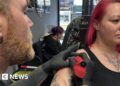
In the seaside town of Weymouth, England, Gareth Pennell, owner of ‘The Drawing Room’ tattoo studio, is grappling with a digital revolution that is vibrating through the needles of the global body art industry. While the act of tattooing remains one of the few truly manual trades in a digital world, the “pre-ink” phase,the creative consultation and design process,is being disrupted by Generative Artificial Intelligence.
For Pennell and thousands of artists globally, tools like Midjourney and DALL-E 3 are no longer futuristic novelties; they are functional workplace assistants. However, as Pennell recently noted, while AI can save hours of sketching, it introduces a paradoxical complexity that threatens to make the actual execution of a tattoo more difficult.
The New Digital Stencil
Historically, a custom tattoo required hours, if not days, of back-and-forth between client and artist. The artist would hand-draw drafts, often refining concepts through multiple iterations. Today, an artist can input a client’s vague prompt—“a neo-traditional owl wearing a crown in a thunderstorm”—and receive four high-fidelity renderings in under sixty seconds.
This efficiency is a boon for the “business” of art. It allows studios to increase throughput and reduces the “unpaid labor” of the design phase. Yet, Pennell warns that AI lacks an understanding of the medium’s physical constraints. An AI-generated design may look stunning on a flat screen but fail to account for the way skin stretches, the way ink spreads over time (known as “blowout”), or the anatomical flow of a human muscle.
“AI can save time, but it can also make the job harder,” Pennell observes. The challenge lies in managing client expectations when an AI produces a design with impossible levels of detail or lighting that cannot be replicated with a needle and pigment.
Key Takeaways for the Industry
- The Shift from Creator to Editor: Tattoo artists are increasingly moving away from “blank page” creation toward a role of digital curation and refinement. The skill is no longer just drawing, but “prompt engineering” and then retrofitting AI designs into tattooable formats.
- The “Anatomical Gap”: AI does not understand the 3D canvas of the human body. Professional artists must spend significant time “fixing” AI hallucinations,such as extra limbs, incorrect shading for skin aging, or designs that ignore the natural contours of the body.
- Intellectual Property and Ethics: As AI scrapes the portfolios of world-class artists to train its models, the tattoo industry faces a looming crisis regarding “style theft.” This raises questions about the value of a “bespoke” design in an era of algorithmic generation.
Professional Analysis: The Future of Body Art
The integration of AI into the tattoo industry represents a microcosm of the broader shift in the creative economy. From a business perspective, the primary benefit is the democratization of high-level concepts. Small-town shops can now offer the visual complexity once reserved for elite studios in London or New York.
However, the industry faces a “commoditization trap.” If every artist uses the same algorithms, the unique “hand” of the artist,the very thing that drives premium pricing,could be diluted. We are likely to see a market bifurcation: a high-volume “automated” tier where AI-generated flash is the norm, and a premium “artisan” tier where the absence of AI is marketed as a luxury feature.
Furthermore, the legal landscape remains a minefield. If a client brings in an AI-generated image, who owns the copyright to the final tattoo? Current U.S. and U.K. copyright offices have ruled that AI-generated content cannot be copyrighted, potentially leaving artists without legal recourse if their work is copied.
For entrepreneurs like Pennell, the path forward is a hybrid model. The goal is to leverage AI to eliminate the “drudge work” of initial sketching while maintaining the human technical expertise required to ensure that art remains beautiful ten years after the client leaves the chair. In the tattoo world, the machine may help with the vision, but the soul,and the safety,remains firmly in human hands.